About Eve Air Mobility Manufacturing Company
Eve Air Mobility and the Urban Air Mobility UAM Vision
Eve Air Mobility steps into the spotlight as a serious contender in Urban Air Mobility UAM. Founded in 2020 as a spin-off from Embraer, the company operates from Melbourne, Florida, with deep engineering roots in Brazil. And that dual identity matters. Startup energy on one side, aerospace discipline refined over 55 years on the other.
According to market forecasts, the advanced air mobility AAM sector could surpass $1 trillion globally by 2040. Eve Air Mobility positions itself early in that arc. Publicly traded under EVEX on the NYSE and EVEB31 on Brazil’s B3 exchange, the company pairs capital access with a focused roadmap toward entry into service in 2027.
Electric Vertical Take Off and Landing eVTOL Aircraft Design
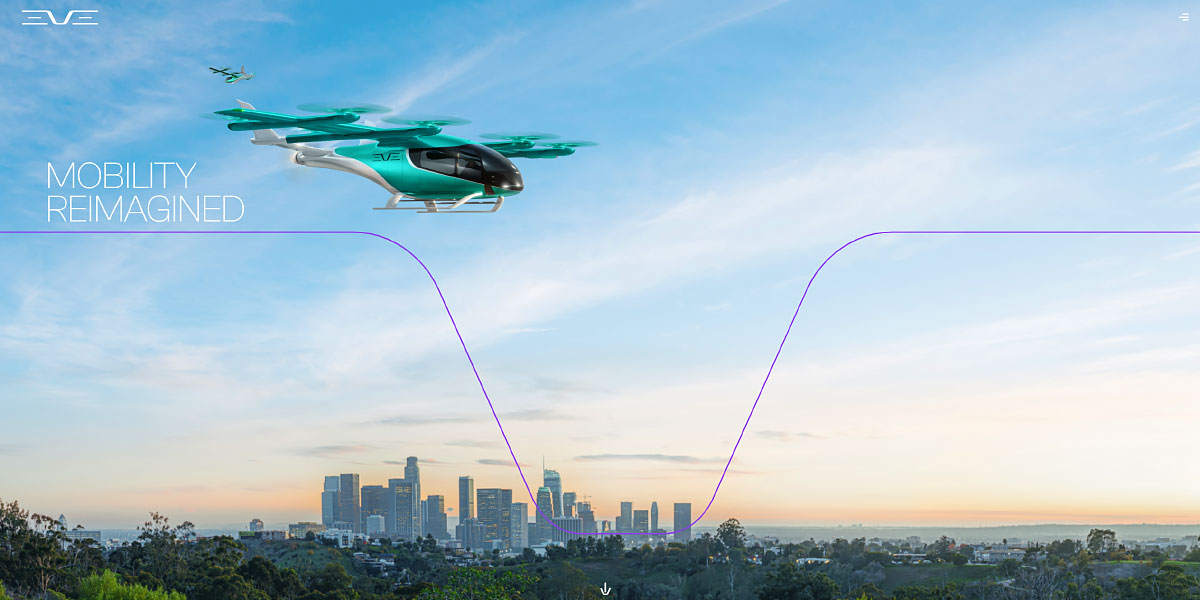
At the core sits Eve’s electric vertical take off and landing eVTOL aircraft. The configuration follows a lift plus cruise architecture. Eight dedicated lift rotors handle vertical operations, while fixed wings and rear pusher propellers support forward cruise. And that separation improves efficiency and redundancy.
The aircraft targets a range of about 60 miles, roughly 100 kilometers. Capacity at entry into service includes four passengers plus a pilot, with long-term plans for up to six passengers in autonomous mode. Zero emission aircraft performance reduces direct CO₂ output compared with conventional helicopters, which often burn hundreds of pounds of fuel per hour.
- 100 percent electric propulsion
- Eight lift rotors for vertical flight
- Fixed wings with pusher propellers for cruise
Certification Strategy with FAA ANAC EASA Authorities
Certification defines the real proving ground. Eve pursues parallel validation with Brazil’s ANAC, the U.S. FAA, and Europe’s EASA. And that multi-agency pathway increases global deployment potential. Type certification remains targeted for 2027, followed by first customer deliveries.
In late 2025, the company completed its first uncrewed hover flight using a full-scale prototype. Plans for 2026 include hundreds of additional test flights across six conforming prototypes. Research shows that phased envelope expansion improves reliability metrics before commercial service.
Eve TechCare Services and UAM Ecosystem Integration
Eve Air Mobility extends beyond aircraft manufacturing. Through Eve TechCare services, the firm provides flight operations support, maintenance programs, pilot training, and aftermarket solutions. And that structure strengthens lifecycle value for operators.
The approach mirrors traditional aerospace support networks. Data reveals that aftermarket services often represent 40 percent or more of long-term aviation revenue streams. Eve positions TechCare as a central pillar, serving its own fleet and potentially other eVTOL operators.
- Maintenance planning and parts support
- Training partnerships including simulators
- Operational analytics and fleet monitoring
Vector Urban Air Traffic Management and Scalable Operations
Urban skies demand coordination. Eve addresses that with Vector, its urban air traffic management solution. Designed for high-density operations, Vector enables routing, scheduling, and traffic separation for electric air taxi fleets. And scalability becomes essential as cities integrate dozens, then hundreds, of daily flights.
According to transportation data, commuters in major cities lose over 50 hours annually in traffic congestion. Sustainable urban transportation through aerial corridors offers measurable time savings. Vector supports that ambition with digital coordination tools tailored for advanced air mobility AAM.
Manufacturing Expansion in Taubaté Brazil and Global Partnerships
Production scales in Taubaté, Brazil, leveraging Embraer’s industrial expertise. And that connection reduces ramp-up risk. Manufacturing readiness aligns with projected certification timelines toward 2027 entry into service.
Eve has secured a diversified order backlog, including a firm order from Japan’s AirX for two eVTOL aircraft with options for 48 more. In early 2026, the company completed a $150 million debt financing round to support development and industrialization. Capital strength supports sustained research, testing, and supplier engagement.
Sustainable Urban Transportation and ESG Commitment
Eve Air Mobility frames its strategy around sustainable urban transportation and ESG priorities. Electric propulsion reduces local emissions and lowers acoustic footprint compared with many rotorcraft. And quieter operations help integrate air taxis into community settings.
Passenger experience also plays a role. Cabin design emphasizes accessibility, human-centric layouts, and smooth boarding. For commuters seeking faster connections between city centers and airports, electric air taxi services promise shorter travel times measured in minutes rather than hours.
And when you look at the big picture, Eve Air Mobility connects aerospace pedigree with startup agility. It advances electric vertical take off and landing eVTOL technology while shaping a full UAM ecosystem integration strategy. For investors, operators, and city planners, that layered approach places Eve among the leading names in the race toward practical electric air mobility.