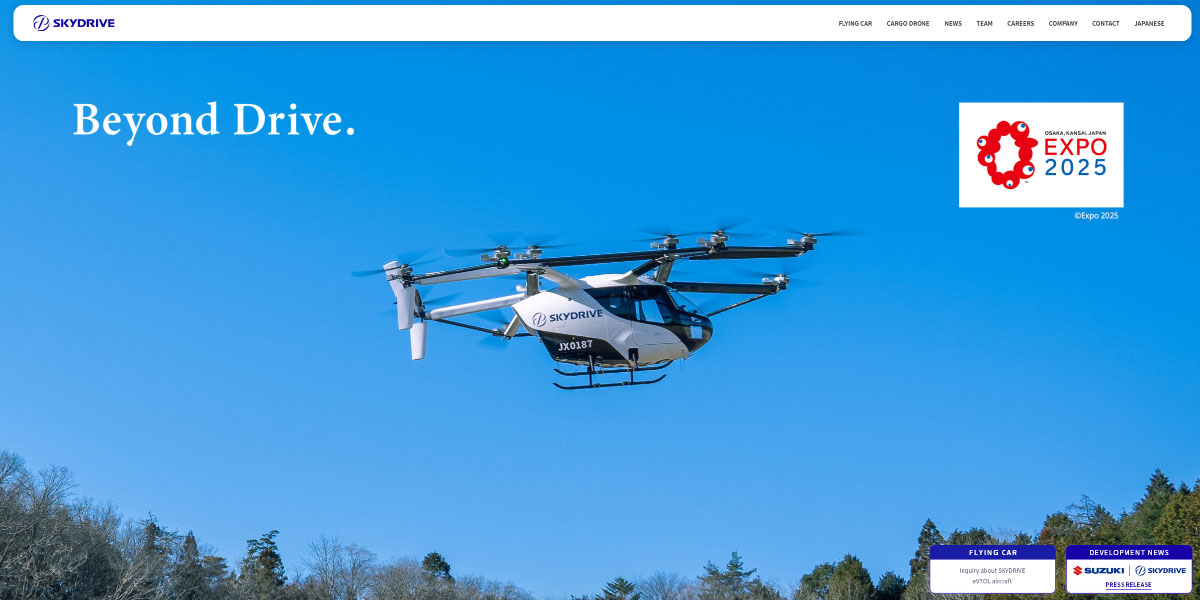
About SkyDrive Manufacturing Company
SkyDrive: Japan’s Flying Car Contender Turning Rooftops into Runways
SkyDrive Inc. isn’t just building a buzz—it’s building flying cars that might land on your office tower by 2026. This Japanese eVTOL startup, based in Toyota City, is betting big on its SD-05 aircraft to make short hops across town faster, quieter, and greener. With a team helmed by CEO Tomohiro Fukuzawa and CTO Nobuo Kishi, SkyDrive is trying to make airborne taxis part of the daily grind—minus the road rage.
Their goal? Make urban air mobility as normal as grabbing a cab. With the SD-05’s 100 km/h top speed, rooftop landing capability, and whisper-quiet electric thrust, SkyDrive’s betting that short-range, three-seat flights will fill a gap no subway can solve.
SD-05 Electric Air Taxi: Compact, Capable, and Rooftop-Ready
Let’s cut to the chase—the SkyDrive SD-05 is no sci-fi fever dream. It’s a fully electric, three-seat eVTOL aircraft designed for quick city hops. The range isn’t going to break records—10 to 15 kilometers per trip—but it’s built for dense cities where ground travel just can’t keep up.
Powered by 12 propellers and a Distributed Electric Propulsion system, the SD-05 leans hard into redundancy and safety. And it looks the part too—sleek enough to win an iF Design Award in 2023. That’s form meeting function, without a gallon of jet fuel in sight.
Key SD-05 Specs:
- Max speed: 100 km/h
- Range: 10–15 km per flight
- Seats: 3 passengers (pilot + 2)
Suzuki Partnership: From Factory Floor to Flight Deck
Suzuki isn’t just investing—it’s building. Production of the SD-05 started at Suzuki’s Shizuoka plant in March 2024, with a targeted rollout of 100 eVTOLs per year. That manufacturing muscle is helping SkyDrive move past the prototype phase, one fuselage at a time.
And it’s not just Japan. SkyDrive’s got one eye on the U.S., too—with plans for a South Carolina hub announced back in 2023. It’s a clever play, leveraging warm weather and strong aerospace infrastructure to crack into the American urban air mobility market before others get airborne.
Certifications in Progress: JCAB and FAA Taking Notice
Anyone can build a prototype, but certification? That’s where dreams either fly or flop. SkyDrive is currently deep into the approval gauntlet—already securing a G-1 type certification basis from JCAB in early 2025. Over in the U.S., the FAA accepted their application in 2024, signaling that SkyDrive is playing by the rulebook on both sides of the Pacific.
It’s a long road—especially for a new class of aircraft—but their timeline points to commercial ops by 2026. If they pull that off, they’ll beat out a few bigger names with deeper pockets.
JAXA and Thales: Safety, Noise, and Smarts Built In
SkyDrive doesn’t fly solo on tech. The Japanese Aerospace Exploration Agency (JAXA) is on board to study urban noise profiles, while Thales is providing advanced flight controls under the FlytRise banner. It’s the kind of partnership lineup that makes regulators nod and passengers breathe easy.
With 12 independent propellers, multiple backups, and a focus on low-noise operations, SkyDrive’s ticking the boxes that matter to both city planners and aviation nerds.
SkyDrive SD-03: The Flight That Started It All
Before the SD-05, there was the SD-03—a single-seat prototype that made Japan’s first crewed eVTOL flight back in August 2020. It wasn’t long-distance, but it proved the tech worked, and it gave SkyDrive major street (or sky) cred. That flight turned heads in Japan and laid the groundwork for everything that followed.
It was a moment that turned “someday” into “actually, today,” and it set the tone for a startup that doesn’t mind being first—even if that means flying before all the pieces are in place.
Expo 2025 and Global Reach: SkyDrive’s Real Test Flight
Here’s the stage: Osaka, 2025. That’s where SkyDrive plans to show the SD-05 in action as part of a live demonstration at Expo 2025. It's more than just PR—this is their chance to prove to the world that short-hop flying cars are ready to earn their wings.
And SkyDrive’s ambitions don’t end in Japan. With manufacturing through Suzuki, noise studies via JAXA, FAA filings, and even a planned presence in India with Marut Drones, the company is taking global expansion seriously. Compact design and rooftop versatility make SkyDrive a fit for crowded cities everywhere, not just Tokyo.
Challenges Still Hovering: Range, Scale, and Public Buy-In
No sugarcoating it—SkyDrive’s facing the same headwinds as the rest of the eVTOL crowd. Limited range, regulatory uncertainty, and public hesitation about flying taxis still loom large. And with just three seats, the SD-05 won’t be moving mass transit loads anytime soon.
There’s also the reality of competition. Companies like Joby and Archer are betting on longer ranges and bigger payloads. But where SkyDrive wins is simplicity: fewer moving parts, lighter airframes, and urban-first design thinking.