JETSON ONE: Price, Range, and Technical Specs
JETSON ONE 2026 is a Swedish ultralight electric vertical take off aircraft designed for single seat recreational flight. Powered by a 13.5 kWh lithium ion battery and eight motors producing 88 kW or 118 hp, it reaches 102 km/h and flies up to 17 minutes. Weighing 86 kg, it qualifies under FAA Part 103 in the United States, enabling personal electric flight without a traditional pilot license.

| Starting Price | $128,000 |
| Model Year | 2026 |
| Country of Manufacturing | Sweden |
| Flying Time | 17 min |
| Battery Size | 13.5 kWh |
| Power | Fully Electric eVTOL hp |
* Minimum price set for the base trim by the manufacturerr, excluding taxes and additional options

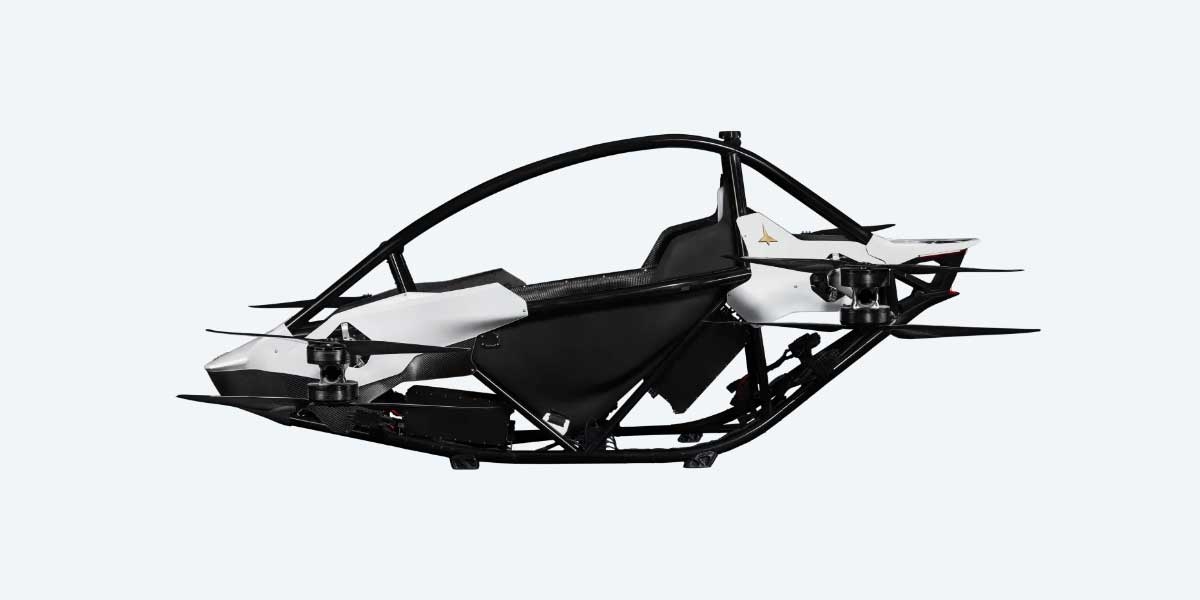
Exterior and Interior photos of JETSON ONE


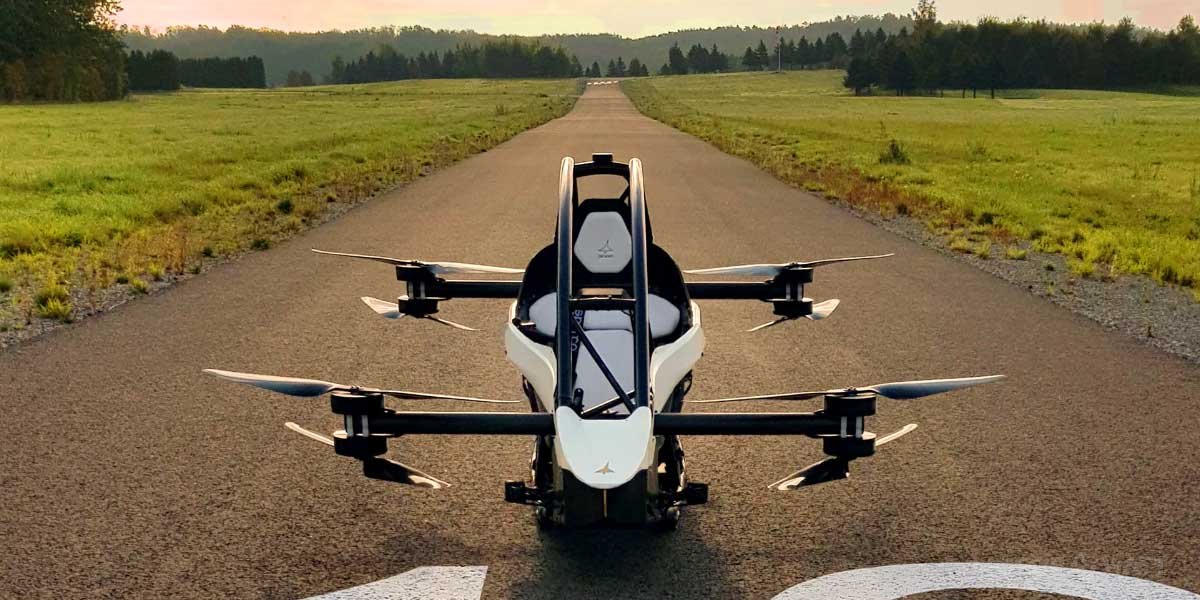
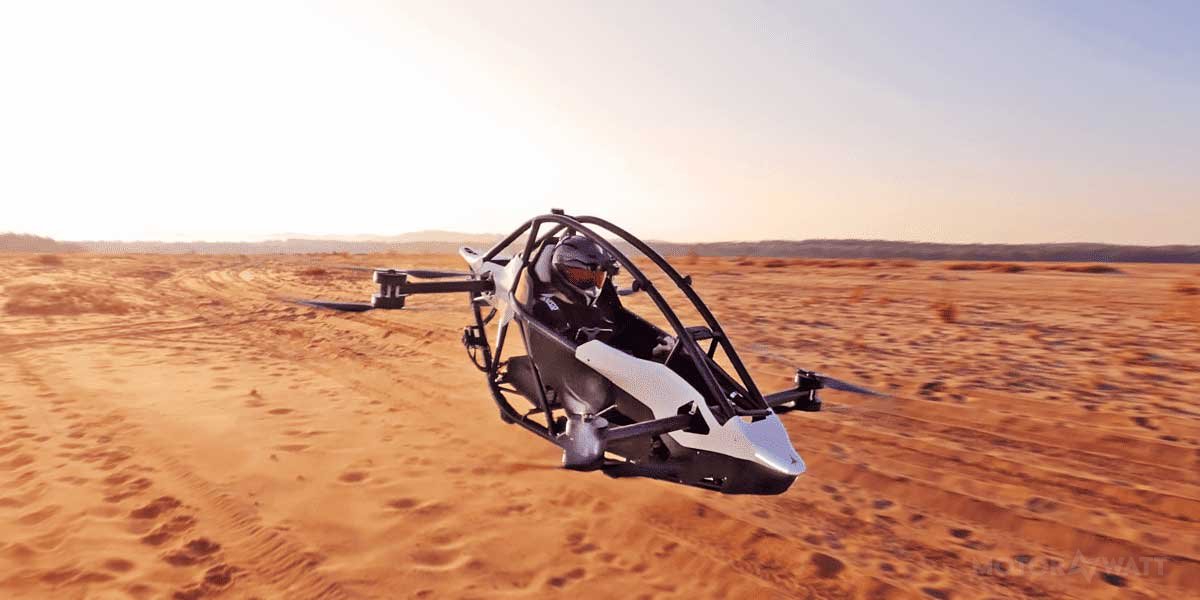
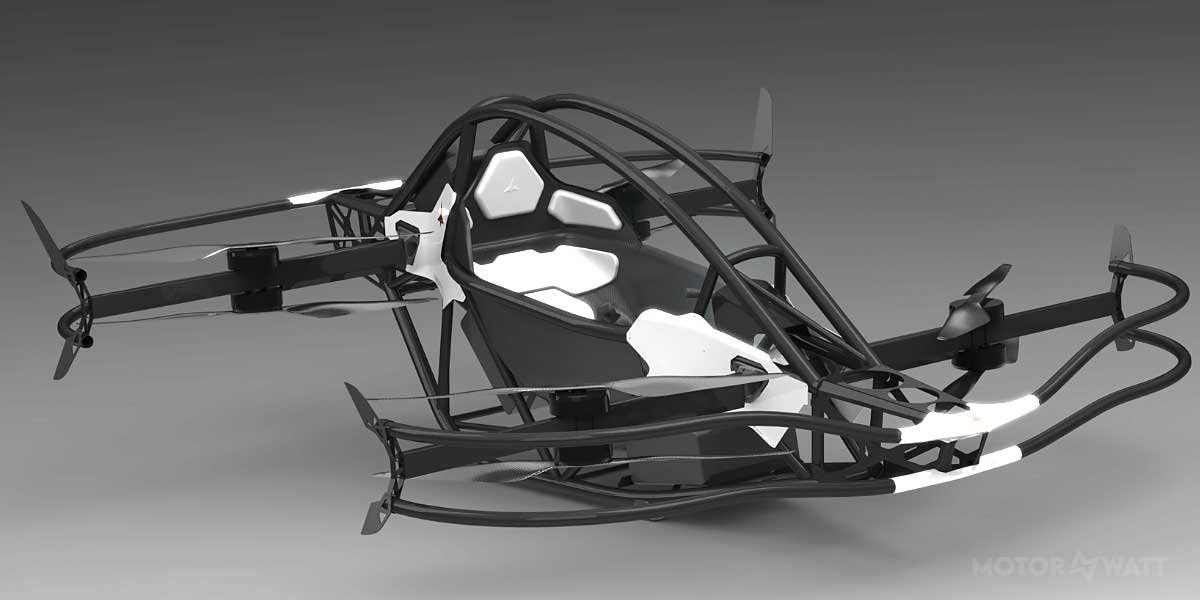
JETSON ONE Review: Early Impressions & Tech Analysis
JETSON ONE 2026 Introduction:
JETSON ONE enters 2026 as one of the most talked about personal electric aircraft in the ultralight eVTOL space. Built by Jetson Aero, a Swedish innovator with production in Italy and Poland, it targets recreational pilots who crave direct, backyard flight. Classified under FAA Part 103, it removes the pilot license barrier in the United States. That regulatory angle changes the conversation overnight. With a 13.5 kWh lithium ion battery, eight brushless motors producing 88 kW or 118 hp, and a top speed of 102 km/h or 63 mph, it delivers sports car intensity in vertical form. Starting at $128,000 USD (€107,870), it positions itself as a premium electric aircraft rather than an urban taxi. And yes, it feels like a racing drone scaled for humans.
- Manufactured in Sweden by Jetson Aero with assembly in Italy and Poland.
- 2026 model year units ship through 2025 and 2026, with new orders scheduled for 2027.
- Ultra-light 86 kg frame built from aluminum, carbon fiber, and Kevlar composites.
- Base price of $128,000 USD (€107,870), targeting aviation hobbyists and high net worth enthusiasts.
- Designed as a personal electric aircraft under FAA Part 103 regulations.
How Much Does the JETSON ONE Cost?
The JETSON ONE price starts at $128,000 USD (€107,870). That places it firmly in the premium ultralight eVTOL category, aimed at aviation enthusiasts rather than commuters.
| Trim Level | PRICE | KEY FEATURES |
|---|---|---|
|
Base Model
|
Single seat ultralight eVTOL with 13.5 kWh lithium ion battery. Eight brushless motors generate 88 kW or 118 hp. Software limited top speed of 102 km/h or 63 mph. Flight time up to 17 minutes depending on pilot weight. Triple redundant flight computer, LiDAR terrain tracking, ballistic parachute, and foldable 2,845 mm frame.
|
Pricing remains transparent. No trim ladder, no hidden performance package. A 2026 production slot requires an $8,000 USD (€6,742) non refundable reservation. And that simplicity reinforces its niche focus. Buyers secure a standardized build optimized for recreational electric flight. Battery, motor output, and safety systems remain identical across units. That uniform engineering approach keeps weight at 86 kg or 189 lb and supports the FAA Part 103 classification.
Engine, Battery, and Performance Specs:
Battery & Charging Specifications
The aircraft relies on a 13.5 kWh high discharge lithium ion battery pack tuned for short but intense sorties. Expect up to 17 minutes of flight time under standard load, with cruise speeds around 60 km/h or 37 mph for efficiency. Charging from 230 to 240V AC takes about one hour. A 110V outlet stretches that to roughly two hours. Real world range hovers near 17 km or 10.5 miles at the software limited top speed. For a backyard aviation platform, that proves adequate for short exploratory hops.
- Battery capacity: 13.5 kWh lithium ion
- Flight time: up to 17 minutes
- Range: approx. 17 km or 10.5 miles
- Charging: 1 hour on 230 to 240V AC
Electric Motor Specifications
Eight brushless motors sit on four arms extending from the aluminum space frame. Combined output reaches 88 kW, equivalent to 118 hp. That power-to-weight ratio rivals certain light aircraft categories. Each rotor operates independently, monitored by a triple redundant flight computer. If one motor drops offline, the system maintains stability. And that redundancy anchors confidence in single seat operation.
- Total power: 88 kW or 118 hp
- Eight brushless electric motors
- Triple redundant flight control system
- Maximum pilot weight: 95 kg or 209 lb
Performance Specifications
Acceleration feels immediate due to vertical thrust. Top speed reaches 102 km/h or 63 mph. The flight computer limits bank angles for stability. Hover mode allows hands free suspension mid air. Autoland engages during emergency scenarios. At only 86 kg curb weight, equivalent to 189 lb, it achieves impressive thrust efficiency.
- Top speed: 102 km/h or 63 mph
- Curb weight: 86 kg or 189 lb
- Single passenger capacity
- Ballistic parachute system
Advantages become clear quickly. Ultralight classification simplifies operation. Compact folded width of 900 mm or 35.4 inches enables SUV transport. LiDAR terrain tracking enhances obstacle avoidance. And automated leveling software stabilizes aggressive maneuvers.
Exterior and Interior Features
Exterior Design
Exterior design centers on an all aluminum space airframe with carbon fiber and Kevlar reinforcements. Dimensions measure 2,845 mm long, 2,400 mm wide, and 1,030 mm tall. Folded width drops to 900 mm for storage. LED lighting integrates into the frame for aerial visibility. Carbon fiber propellers reduce acoustic footprint while optimizing thrust. The visual stance resembles a skeletal racing car suspended on rotors.
Interior & Technology
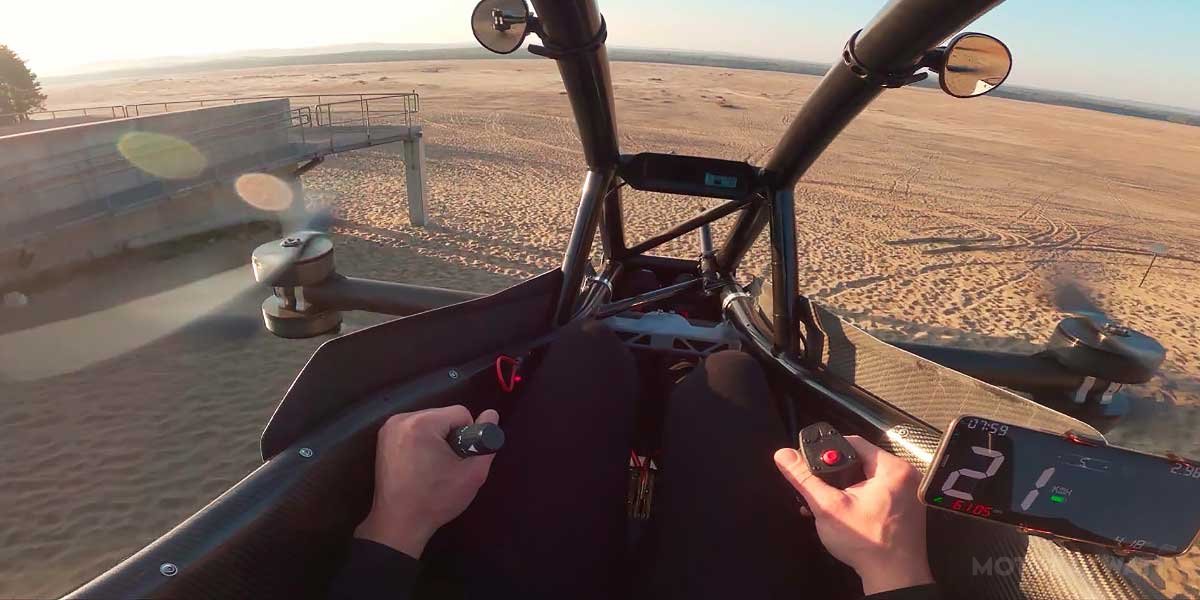
The cockpit remains open air and race inspired. A fixed bucket seat secures the pilot with a multi point harness. A dedicated tablet displays telemetry including battery voltage and altitude. Control occurs via three axis joystick and throttle lever. LiDAR sensors scan terrain in real time. The triple redundant computer manages motor distribution and hover stability.
Exterior minimalism reduces mass. Interior simplicity enhances intuitive operation. Together they create a focused flying sports machine aimed at enthusiasts who value direct control and aerial agility.
Pros and Cons:
Pros
- FAA Part 103 ultralight classification in the United States
- High power to weight ratio with 88 kW output
- Ballistic parachute and LiDAR safety systems
- Foldable frame for SUV transport
- Rapid one hour charging on 240V
Cons
- Limited 17 minute flight time
- Single passenger only
- Open cockpit exposure to weather
- Premium $128,000 USD (€107,870) price
Market position & Expert Data:
The ultralight eVTOL segment remains niche yet expanding. According to Reuters, personal electric aircraft startups secured over 20 percent more venture funding in 2025 compared with 2024. Data reveals growing demand for recreational aerial platforms. Research from McKinsey & Company projects the broader advanced air mobility sector could exceed $20 billion by 2030. Within that context, the Swedish manufacturer positions its aircraft as a premium lifestyle product.
In the United States, FAA Part 103 rules allow operation without a pilot license in uncontrolled airspace. That regulatory benefit fuels domestic interest. Deliveries already reach Germany and the United Kingdom under experimental classifications. And sold out production through 2026 demonstrates strong early adoption among aviation hobbyists.
Conclusion:
JETSON ONE 2026 offers personal electric flight in its purest form. With 88 kW of output, 13.5 kWh battery capacity, and 102 km/h top speed, it delivers raw aerial exhilaration. FAA Part 103 classification simplifies access for American buyers. At $128,000 USD (€107,870), it targets enthusiasts who crave agility, innovation, and sky level freedom.
Watch the Video Overview


Full specifications
Model Specs
| Specification | Actual Data |
|---|---|
|
Model Name
|
JETSON ONE
|
|
Model Year
|
2026
|
|
Vehicle Class
|
Ultralight eVTOL Aircraft
|
|
Manufacturer
|
Jetson Aero
|
|
Country of Origin
|
Sweden
|
|
Assembly Locations
|
Italy and Poland
|
Performance
| Specification | Actual Data |
|---|---|
|
Power Type
|
Fully Electric eVTOL
|
|
Motor Configuration
|
Eight Brushless Motors
|
|
Total Power Output
|
88 kW (118 hp)
|
|
Maximum Speed
|
102 km/h (63 mph)
|
|
Cruise Speed
|
60 km/h (37 mph)
|
Battery and Charging
| Specification | Actual Data |
|---|---|
|
Battery Capacity
|
13.5 kWh Lithium Ion
|
|
Charging Time 230 to 240V AC
|
Approx. 1 hour
|
|
Charging Time 110V AC
|
Approx. 2 hours
|
Estimated Range Data
| Specification | Actual Data |
|---|---|
|
Maximum Flight Time
|
Up to 17 minutes
|
|
Estimated Range
|
17 km (10.5 miles)
|
Body Specifications
| Specification | Actual Data |
|---|---|
|
Length
|
2,845 mm (112 in)
|
|
Width
|
2,400 mm (94.5 in)
|
|
Height
|
1,030 mm (40.5 in)
|
|
Folded Width
|
900 mm (35.4 in)
|
|
Curb Weight
|
86 kg (189 lb)
|
Exterior Design Features
| Specification | Actual Data |
|---|---|
|
Frame Material
|
All Aluminum Space Airframe
|
|
Composite Materials
|
Carbon Fiber and Kevlar
|
|
Lighting System
|
Integrated LED Visibility Lighting
|
Interior Design and Materials
| Specification | Actual Data |
|---|---|
|
Seating
|
Single Racing Style Bucket Seat
|
|
Safety Harness
|
Multi Point Harness System
|
Cabin Technical Features
| Specification | Actual Data |
|---|---|
|
Flight Computer
|
Triple Redundant Digital Flight Computer
|
|
Control Interface
|
Three Axis Joystick and Throttle Lever
|
|
Obstacle Detection
|
LiDAR Based Terrain Tracking
|
|
Emergency System
|
Ballistic Parachute Deployment
|
F.A.Q. about JETSON ONE
What category does this ultralight eVTOL aircraft fall under in the United States?
It qualifies as an ultralight aircraft under FAA Part 103, which allows recreational operation in uncontrolled airspace without a traditional pilot license.
- Single seat only
- Empty weight around 86 kg or 189 lb
- Designed strictly for recreational electric flight
What is the battery capacity and usable energy for flight?
The JETSON ONE uses a 13.5 kWh lithium ion battery pack engineered for high discharge output and short performance focused flights.
- Optimized for up to 17 minutes of flying time
- Supports rapid 88 kW total motor output
- Designed for quick recharge cycles
What is the real world flight range on a single charge?
The JETSON ONE delivers approximately 17 km or about 10.5 miles of range at moderate cruise speeds around 60 km/h or 37 mph.
- Higher speeds up to 102 km/h reduce endurance
- Pilot weight up to 95 kg influences duration
- Wind and temperature affect efficiency
How long does it take to fully charge the lithium ion aviation battery?
The JETSON ONE charges in about one hour on a 230 to 240V AC outlet and roughly two hours on a standard 110V household connection.
What is the price in the USA and Europe?
The JETSON ONE base price stands at $128,000 USD (€107,870), with a 2026 build slot reservation requiring an $8,000 USD (€6,742) deposit.
How powerful is the electric motor system compared with light aircraft?
The eight brushless motors produce 88 kW or 118 hp, giving it a high power to weight ratio that rivals certain traditional ultralight aircraft.
- Independent motor monitoring
- Triple redundant flight computer
- Stable hover and assisted leveling
What safety systems support personal electric flight?
Advanced safety features include LiDAR based obstacle detection, a triple redundant control system, autoland capability, and a ballistic parachute for low altitude emergencies.
- Automated hover function
- Real time rotor temperature monitoring
- Protective aluminum safety cell
Can this compact foldable airframe fit into a standard SUV or trailer?
Yes, the arms fold to a width of 900 mm or 35.4 inches, enabling transport inside a large SUV or on a compact trailer.
- Full width deployed: 2,400 mm or 94.5 inches
- Length: 2,845 mm or 112 inches
- Height: 1,030 mm or 40.5 inches
Is this single seat flying vehicle suitable for cold climates in Europe?
Open cockpit design exposes the pilot to weather, so cold conditions require protective gear and careful battery management for optimal lithium ion performance.
- Cold air can reduce flight time slightly
- Battery efficiency improves in moderate temperatures
- Pre flight checks remain essential in winter