Elektra Solar Company Overview
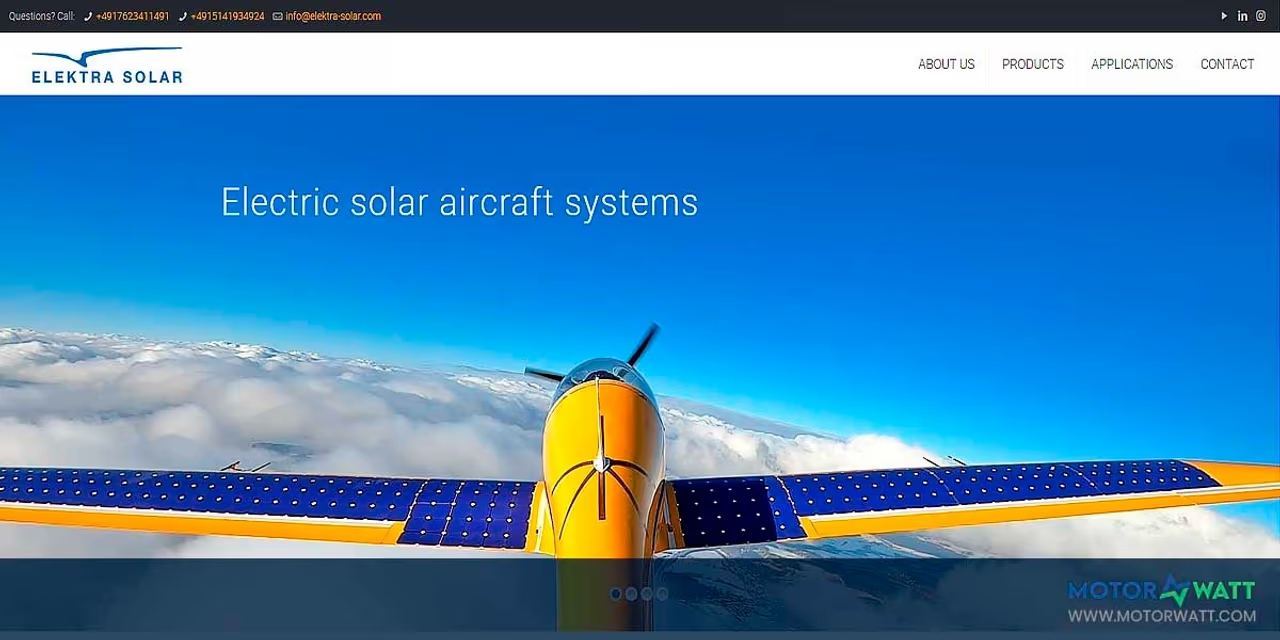
Elektra Solar is a Germany-based developer of flying electric vehicles, with manned and unmanned aircraft systems for scientific, commercial, surveillance, mapping, and remote sensing work. Its named aircraft include Elektra One, Elektra One Solar, Elektra Two Solar, and Elektra Two Solar UAS. The company also handles aircraft design, avionics, electronics, robotics, safety-critical software, payload integration, and mission software. Buyers seeking tailored electric aviation platforms can consider a partner spanning crewed aircraft and autonomous systems. Solar flight milestones and autonomous operation up to 10 km point toward practical aerial applications.
Manufacturer Description
Elektra Solar serves specialized electric aviation missions
Elektra Solar develops manned and unmanned aircraft systems for scientific, commercial, surveillance, mapping, and remote sensing work. Its main appeal lies in one integrated skill set covering aircraft design, avionics, electronics, robotics, and safety-critical software.
That breadth suits buyers seeking tailored aerial systems rather than an off-the-shelf aircraft. Elektra Solar also supports payload integration, platform customization, and mission software creation.
A connected history supports its aircraft work
The company began in 2011 as PC-Aero GmbH under Kalin Gologan. The Elektra One electric aircraft appeared in March 2011 and won the Lindbergh Prize at Oshkosh that year.
Elektra-UAS GmbH followed in 2012, focusing on unmanned systems and applications. PC-Aero GmbH and Elektra-UAS joined in 2016 under the Elektra Solar GmbH name.
That timeline gives buyers useful context. The company combines experience from electric aircraft development with unmanned aviation and automation.
Milestones show practical progress in electric flight
Elektra One Solar crossed the Alps in 2015 during a solar-powered flight. The achievement demonstrated the company’s work with solar aviation.
Elektra Two Solar made its maiden flight in 2017. In 2019, Elektra Two Solar UAS climbed autonomously to 10 kilometres.
Those milestones matter for buyers assessing technical direction. They show activity across crewed aircraft, solar flight, autonomous control, and unmanned platforms.
- Aircraft design and avionics
- Robotics and electronics
- Payload integration and mission software
- Manned and unmanned air systems
Which buyers should keep Elektra Solar in the running?
Shortlist Elektra Solar when a project needs customized electric aircraft or unmanned systems for defined operational tasks. The company suits organizations that value integrated engineering across airframes, controls, payloads, and software.
Scientific teams may value the crewed and unmanned options for research work. Commercial operators may consider tailored systems for specialized missions. Surveillance, mapping, and remote sensing users have clear reasons to investigate the portfolio.
Buyers seeking a simple consumer aircraft or a broad retail lineup may prefer another type of supplier. Elektra Solar’s evidence points toward project-led aviation rather than everyday personal transport.